The Most Common ‘Deal Killers’ Lenders Don’t Tell You About
- Reconcile bank statements, financial statements and tax returns.
- Disclose every debt and its required payments.
- Prepare explanations and evidence for credit or cash-flow concerns.
Common SBA loan obstacles include inconsistent financial records, undisclosed debt, cash-flow shortfalls and credit issues. Identifying them before applying gives you time to gather explanations and supporting documents. FastWaySBA can help you prepare a clearer financing request for lender review.
At FastWaySBA, we see loan files from business owners who should have been approved but got declined because of problems nobody warned them about. We call these "deal killers", the issues that sink your application before you ever get a fair shot.
The good news? Most of them are preventable if you know what to look for.
Below are the six most common deal killers we see at FastWaySBA, and what you can do to fix them before you ever submit an application.
Bank Statements That Don't Match Your Tax Returns
This is one of the fastest ways to get quietly declined for an SBA loan.
Lenders compare your business bank statements against your tax returns to verify revenue. If the numbers don't line up, it raises immediate red flags, even if there's a perfectly reasonable explanation.
When deposits in your bank account are significantly lower than the revenue on your tax return, underwriters start asking questions like:
- Is there unreported cash income?
- Are there multiple accounts we're not seeing?
- Is the bookkeeping sloppy or is something being hidden?
It doesn't matter if the mismatch is innocent. A confused underwriter is a conservative underwriter, and conservative underwriters decline deals.
The Facts: Lenders don't call to ask for clarification. They just move on to the next file.
How to fix this before you apply:
- Reconcile your books monthly so there are no surprises
- Deposit all business revenue into one primary operating account
- If you have legitimate reasons for discrepancies (seasonality, timing, a big contract that hit in January), document it upfront and include a written explanation with your application
High Utilization on Personal Credit Cards
You can have a 730 credit score and still get declined for an SBA loan.
Most people don't know this, but your personal credit utilization often matters more to SBA lenders than your actual credit score. You could have solid credit history, no late payments, and a score that looks great on paper, but if you're using 60% or more of your available revolving credit, that's a problem.
To underwriters, high utilization signals:
- Financial stress or cash flow issues in your personal life
- Over-reliance on credit to cover gaps
- Risk that you'll struggle to take on more debt
It doesn't matter if you pay off your cards every month. The utilization percentage is calculated based on your statement balance, not what you actually owe after payment.
The Facts: Your credit score gets you in the door. Your utilization decides if you stay.
How to fix this before you apply:
- Get your utilization below 30% at minimum, under 15% is ideal
- Pay down balances before your statement closes, not just before the due date
- Don't open new credit lines right before applying, this can backfire and raise other red flags
Declining Revenue (Even If Still Profitable)
Profit doesn't protect you if your revenue is heading in the wrong direction.
This one catches a lot of business owners off guard. You're still making money, still profitable on paper, so why would a lender decline you? Because SBA underwriters don't just look at whether you're profitable today. They're trying to predict whether you can make 120 monthly payments over the next 10 years.
When revenue is trending down, even slightly, lenders see:
- Weakening demand for your product or service
- Unstable or unpredictable cash flow
- A business that might be losing market position
- Higher risk that you won't be able to service the debt long term
You could be running a tight operation with healthy margins, but if this year's revenue is lower than last year's, that's a red flag that needs to be addressed.
The Facts: Lenders don't fund profitability. They fund trajectory.
How to fix this before you apply:
- Show month-over-month recovery if you've started to bounce back
- Prepare a written explanation for the decline (seasonality, inventory delays, a bad quarter, loss of a one-time contract) and include it with your application
- Submit updated year-to-date financials that demonstrate stabilization or growth
- If possible, wait to apply until you have 2-3 months of upward trend to point to
Current Legal Proceedings
If you're in the middle of any legal dispute, most SBA lenders won't touch your application.
This one isn't about whether you did anything wrong. It's about uncertainty. When an owner or business is involved in civil or criminal litigation, lenders can't accurately assess the financial risk. A lawsuit could result in judgments, settlements, legal fees, or liens that completely change your ability to repay the loan. Until the dust settles, underwriters won't move forward.
The types of legal proceedings that kill SBA deals include:
- Divorce proceedings (doesn't matter if you're the plaintiff or defendant)
- Lawsuits from vendors, customers, or former employees
- Contract disputes or partnership disagreements in litigation
- Any pending criminal matter involving an owner
- Unresolved judgments or liens tied to past cases
It doesn't have to be a big dramatic lawsuit. Even a minor dispute that's technically "open" can stall or sink your application.
The Facts: SBA lenders aren't in the business of guessing how your legal situation will play out. They'll wait, or they'll just decline.
How to fix this before you apply:
- Resolve or settle any open litigation before submitting a full application
- If a case is close to being finalized, ask your attorney for a timeline and wait it out
- Be upfront with your SBA broker about any legal matters, even ones you think are minor. Better to know early than to get declined three weeks into underwriting.
Co-Borrower Red Flags (The Silent Killer)
Your application is only as strong as your weakest partner.
This is the deal killer that blindsides people the most. You've done everything right, your credit is solid, your financials are clean, your revenue is growing. Then you get declined and nobody tells you why. Turns out your business partner has a tax lien from 2019. Or a bankruptcy that discharged two years ago. Or a credit score sitting at 580.
Here's what most applicants don't realize: if someone owns 20% or more of the business, they have to qualify for the SBA loan too. The lender will pull their credit, review their background, and assess their financial history just like yours. One person's baggage becomes everyone's problem.
Red flags that sink deals through co-borrowers:
- Poor personal credit score
- Outstanding tax liabilities (state or federal)
- Recent bankruptcy (typically within 3 years)
- Open judgments or liens
- Criminal history that shows up on background check
- Previous SBA loan default
And the worst part? Lenders often won't tell you this was the reason. They'll just say the deal didn't work out.
The Facts: You can do everything right and still get declined because of someone else's financial history.
How to fix this before you apply:
- Pull credit and review financials for every owner with 20% or more stake before you apply
- Have an honest conversation with partners about anything that might show up
- If a partner has disqualifying issues, consider restructuring ownership, but know that most lenders require you to wait 6 months after an ownership change before applying
- Remove inactive or silent partners who aren't contributing but could be dragging down your application
Credit Models and E-Tran: Avoid Outdated Universal Cutoffs
Most business owners have never heard of the score that determines whether they get approved.
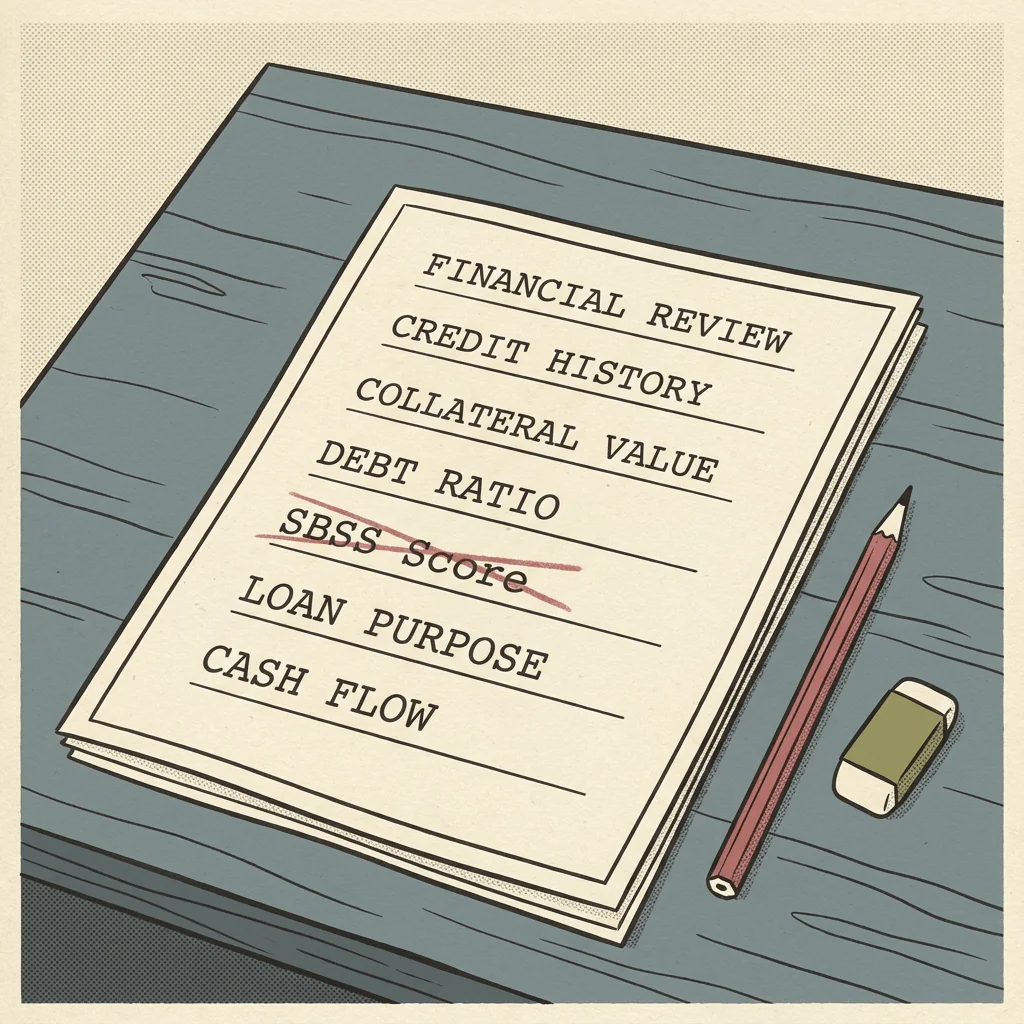
E-Tran is SBA’s electronic loan-processing system, not a universal borrower score. Under SBA’s March 1, 2026 notice, SBA no longer screens or assigns FICO SBSS scores for 7(a) Small applications. Lenders still review credit and repayment ability and may use permitted scoring models. See our E-Tran and SBSS guide.
The SBSS score is different from your personal credit score. It blends multiple data sources together:
- Your personal credit history and score
- Your business credit profile (if one exists)
- Financial data from your application
- Payment history patterns from Experian, Equifax, and Dun & Bradstreet
Credit requirements vary by lender and loan program. Ask which credit model the lender uses, what information it reviews and how it assesses repayment capacity.
A consumer credit report, a lender’s business-risk score, a third-party estimate and an E-Tran application status are different. Confirm the source, date, purpose and consent requirements of any score before relying on it.
Credit, tax and financial issues require review on their own merits. No single score captures every eligibility rule, and improving a score does not guarantee that a lender will approve the application.
How to fix this before you apply:
- Ask the provider what score or estimate it supplies and review its current consent, credit-inquiry and fee disclosures before using it.
- Pay down personal credit card balances to lower your utilization, this is the fastest way to move the needle
- Resolve any outstanding tax liabilities or collections that are dragging down your personal credit
- Make sure all owners with 20% or more stake have their credit in order, the score factors in everyone
- If your score is borderline, work with a broker like FastWaySBA who knows which banks have lower thresholds and can match you accordingly
Poorly Prepared Financials (The #1 Reason Files Fail in Underwriting)
More SBA loan applications die here than anywhere else.
At FastWaySBA we see a lot of loan files, and this is the deal killer that shows up most often. Not bad credit. Not low revenue. Sloppy financials. The SBA 7(a) program is cash-flow based, which means underwriters are studying your numbers closely to figure out one thing: can this business afford to repay this loan? If your financial package is messy, inconsistent, or incomplete, they're not going to chase you down for clarification. They're going to decline and move on.
The most common issues we see:
- Debt schedules that are missing loans, leases, or credit lines the lender will find anyway
- Inaccurate P&L statements that don't match bank deposits or tax returns
- Personal and business expenses mixed together on the same accounts
- Financials that are 6+ months old by the time underwriting reviews them
- Unfiled taxes or unresolved state/federal tax liabilities
- Numbers that just don't tell a coherent story
Underwriters aren't forensic accountants. They're not going to piece together a confusing financial picture and give you the benefit of the doubt. If your package raises more questions than it answers, you're done.
The Facts: Lenders don't fix sloppy files. They decline them.
How to fix this before you apply:
- Get your books cleaned up and reconciled before you start the application process
- Make sure your debt schedule is complete, include everything, even that equipment lease you forgot about
- Separate personal and business expenses if they're currently commingled, and be ready to explain any that can't be separated
- Submit current financials, ideally within 60-90 days of application
- Resolve any outstanding tax issues or at minimum have a payment plan in place and documentation to prove it
- Work with someone who knows what lenders are looking for so your package tells a clear story of repayment ability
Most Deal Killers Are Preventable
Here's what most people don't realize: the majority of SBA declines have nothing to do with whether the business is good or not. They're about the owner's credit profile, the way the financials were prepared, or issues that nobody flagged before the application went in. Stuff that could have been fixed with a little heads up.
Banks won't tell you exactly why you got declined because they don't want the liability, the conflict, or the back and forth. So you're left guessing, wondering if it was your credit, your revenue, your partner, or something else entirely.
At FastWaySBA, we see behind the curtain. We review loan files before they go to underwriting, which means we catch the deal killers early, when there's still time to fix them.
The good news? Almost all of these issues are preventable. A properly packaged file reduces questions, speeds up underwriting, and dramatically increases your approval odds. We've seen it hundreds of times, the difference between a decline and a funded deal often comes down to preparation.
If you've been declined before, or you want to make sure your first application doesn't hit a wall, talk to us before you apply anywhere else. We'll tell you exactly where you stand and what needs to be fixed.
Ready to see if you qualify?
Schedule a free consultation with our team to review your deal before you apply.
Or if you're ready to move forward:
References:
- SBSS/ETRAN Score Explainer (https://www.fastwaysba.com/blog/sba-etran-and-sbss-score-how-sba-loans-are-approved) How the SBSS score works, what factors go into it, minimum thresholds, how to improve it
- Self-Underwriting Mistake (https://www.fastwaysba.com/blog/self-underwriting-the-1-mistake-costing-businesses-their-best-financing-options) Business owners talk themselves out of applying, different lenders have different criteria, just because one bank declined you doesn't mean you're unfundable
- What to Know Before Applying (https://www.fastwaysba.com/blog/what-to-know-before-applying-for-a-sba-loan) General prep guide, covers time in business, credit score, SBSS score, and the fact that profitability isn't always required
- SBA Loan with Losses (https://www.fastwaysba.com/blog/can-i-get-an-sba-loan-with-losses-on-my-tax-return) Yes you can get approved with losses, FastWaySBA specializes in this, losses under 15% of gross sales are workable
- SBAscore.com Get direct access to your SBSS score
- 2024 Small Business Credit Survey (https://www.fedsmallbusiness.org/reports/survey/2024/2024-report-on-employer-firms)
- SBA 7(a) Requirements (https://www.sba.gov/partners/lenders/7a-loan-program/terms-conditions-eligibility)